
Dyna is a simulation program for reflectivity and transmittance of x-rays and optics, aimed at determining structural, magnetic and electronic stackings in ultrathin multilayers.
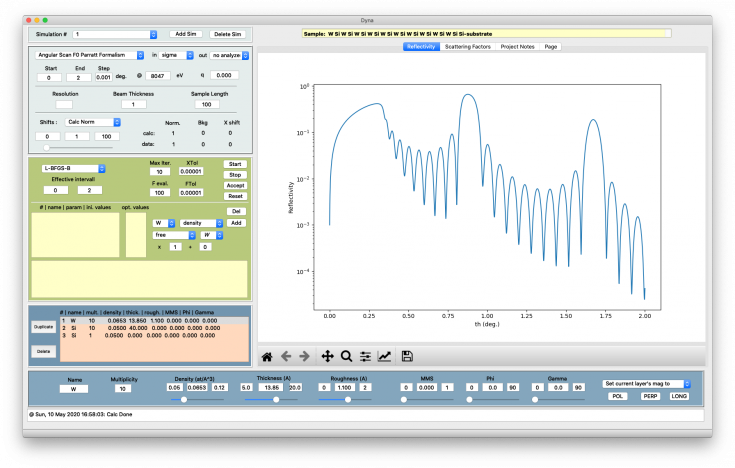
Dyna performs x-ray reflectivity simulation and fits.
It includes anomalous, magnetic and anisotropic components in the index of refraction. Dyna simulates reflectivities either versus angle, or versus x-ray energy, with arbitrary incident and outgoing polarizations; it simulates Kerr and Faraday spectra, and transmittance through thin layers.
All the simulations can be simultaneously fitted against one model.
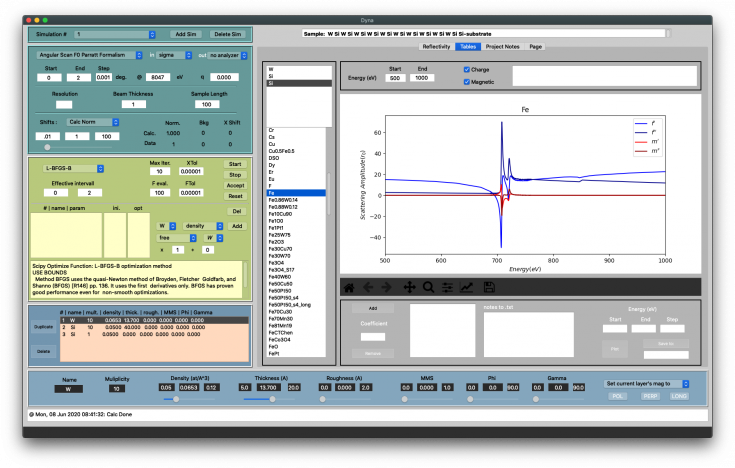
The program integrates a toolbox to create charge and magnetic scattering factors from the tables bundled with the code.
Dyna was also designed for pedagogical aims, making easy to slide parameters for on-the-fly calculations.
Dyna is an on-going free and open-source project, under Python + Qt, or Matlab environments. Dyna can also be freely downloaded, and support is offered to users upon reasonable request.
The next release can be found on GitLab.
Formalisms
- XRR : Recursive Scalar (Parratt)
- XRMR : Boundary-Propagation matrix (Elzo)
- XRMR : Scattering Formalism (Stepanov)
Features
- magnetic-sensitive susceptibility, arbitrary magnetic moment direction described by Euler angles, with the limitation of neglictible spin-orbit coupling in the valence states
- anisotropic susceptibility, in the limitation of an uniaxial symmetry along the depth of the film, for the simulation of oriented molecules or orbitally ordered films (not in python code yet)
- structural and magnetic sensitive transmittance.
- Angular/Q scans
- Energy spectra at fix angle or fix Q
- Polarization Analysis, in and out
- Refinement in user-defined interval, with limits on parameters, and constrains between parameters
- Multifit : one system is refined by simultaneous simulations of various data (angle and energy scans, of any polarization, energy or angle configurations).
- Calculates Scattering Factors from Tables
- (Python Only) Scriptable
Reference
In case of use, please cite the reference paper :
X-ray resonant magnetic reflectivity of stratified magnetic structures: Eigenwave formalism and application to a W/Fe/W trilayer
M. Elzo, et al., Journal of Magnetism and Magnetic Materials, 324 (2), pp. 105-112 (2012)
http://dx.doi.org/10.1016/j.jmmm.20… preprint
Screenshots
Provenance
Dyna was developped from Elza Bontempi‘s Reftool within Matlab environment. Reftool was using Zak’s formalism, which was revisited and simplified, leading to Elzo’s formalisms. Both formalisms are based on the usual matricial optical formalism. The scattering formalism, by Stepanov and Sinha, was coded in order to better treat thick systems, notably for transmittivity.
We swiched to Python for portability. Up to now the two codes are similar in functionalities, the Matlab version having been tested more thoroughly.
Top image: study of the sun reflection on water by Leonardo, from a codex in display at Da Vinci’s exhibition in 2019, Musée du Louvre. (S. G.)